Friday, November 2, 2018

October Drink of the Month - Arancia Julius

Terror of the Deep
I hosted the third edition of "cocktail club" a gathering of friends (and now spouses/significant others, and even a 10 month old) to share recipes, try new things, and work on our drinking palettes on Tuesday night of this week. Longtime collaborator (and friend of the blog) Zack and I were on tap to provide drinks for the evening, and I decided I wanted to go with something really out there. Zack wowed the crowd with his "Terror of the Deep" tiki drink, featuring two rums, falernum, blue curacao, and lots of fresh juices. He won the "drink of the night" from the crowd, so I'll give credit where credit is due, and share the picture he sent to me, to show the "blood in the water" effect he made sinking grenadine in the finished drink. It was a fun drink, and the rums and juices made a sweet, pleasant sipper.

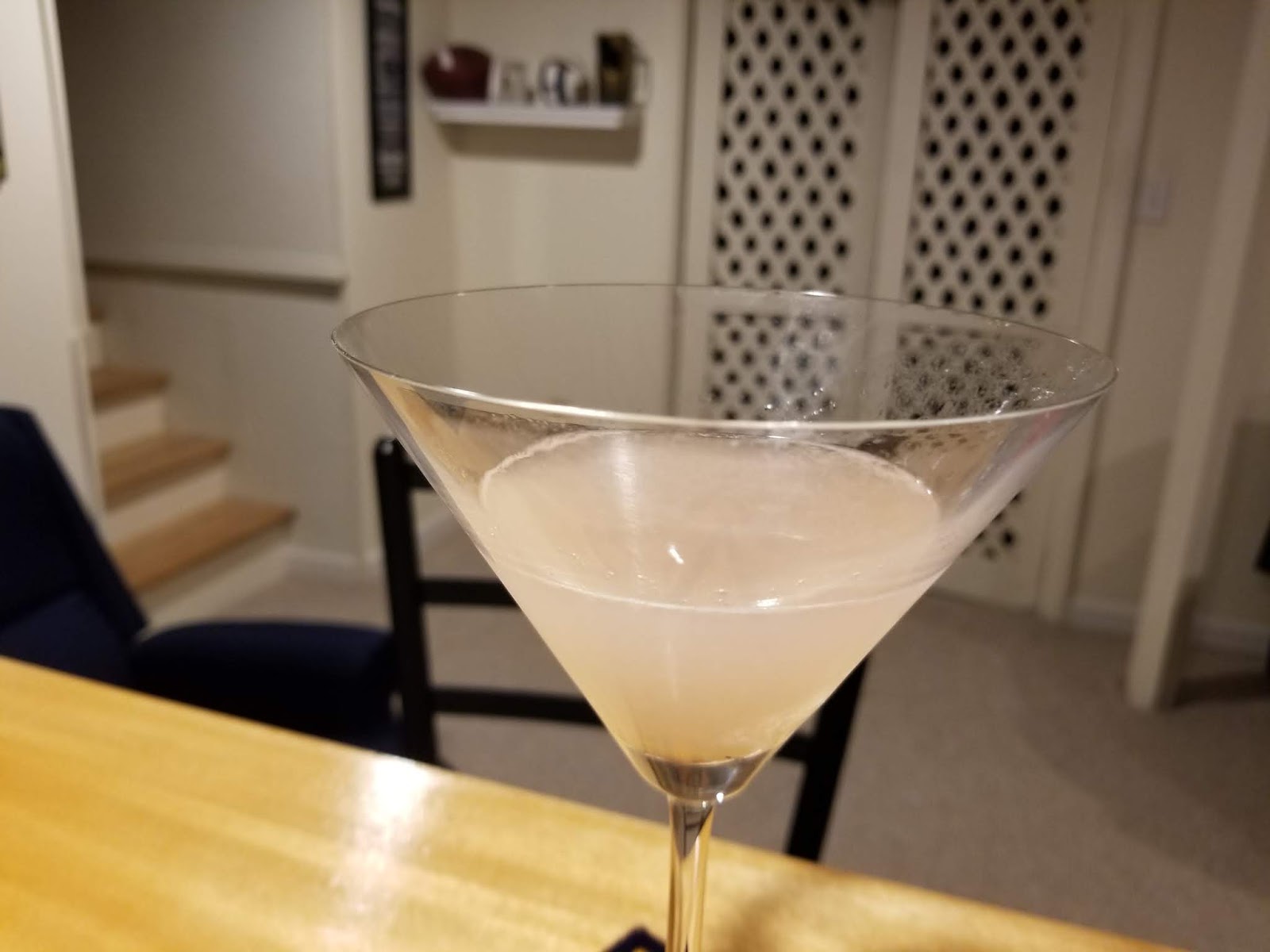
I went another direction, after reading a Imbibe article on their top 10 brunch cocktails. The first drink on the list was the "Arancia Julius" (arancia is orange in Italian) that featured 1.5 oz of Galliano. Woah! I was floored. The only drink I've ever used Galliano for is a Harvey Wallbanger (and our riff, Harvey's Firecracker). But a traditional Harvey only uses 0.5 oz of Galliano. I was already intrigued by the first ingredient. The bartender who created the drink was angling to create a riff on the classic Orange Julius frozen orange drink, while using Harvey Wallbanger ingredients. They subbed genever for vodka, and added pineapple juice and half and half to make it creamy like a shake. I have to say that the result was incredibly refreshing, if a little watery. The recipe calls for a 1/2 oz of soda water on the bottom of the glass when assembling, and another 1/2 oz on top. We decided omitting the soda water helps the drink immensely.

Arancia Julius
Given that small modification, I can happily recommend the Arancia Julius for brunch any time! Here is the recipe for you to make it at home, even if it didn't win drink of the night (although it did beat out a Mary Pickford for second place, so that's something!):

In a mixing tin, combine the following:

1.5 oz Galliano
0.5 oz genever (jonge)
0.5 oz pineapple juice
2 oz orange juice
0.5 oz half and half

Shake over ice, strain into a collins glass filled with ice. Garnish with an orange wheel and/or pineapple flag. If you choose, top with 0.5 oz soda water, but we recommend omitting.

I hope you enjoy your Arancia Julius!


Wednesday, September 12, 2018

September Drink of the Month - Seymour Glass

Last month, Ann and I had the opportunity to travel out of the country, visiting Split, Croatia to celebrate the wedding of my good friend Dolu. The wedding was a blast, and it even made the local paper (and the Google Translate version of this story is hilarious, so give it a read if you're bored). Split itself was a fun, coastal town. It was a nice mix of Italy and Eastern Europe, with a healthy dose of sea salt and olive groves mixed in for good measure. There was pizza and pasta everywhere, but also hearty goulashes with hints of warming spices (Maybe nutmeg? Whatever we had, it was tasty!).

As is my custom when we travel, I went out in search of local spirits. The most common local liquor is palinka, a fruit brandy that is also found with my mother's people in Hungary. We've made a few drinks before with palinka/rakia (specifically, we used slivovitz, which is plum brandy - making a Slivopolitan), but I tend not to serve palinka often. My mother referred to palinka as "rotgut," so it is a hard sell with my family! I did discover one other local liqueur, however. Maraska Orahovac is a form of the northern Italian nocino. It is made from unripe green walnuts, and then sweetened with simple syrup to produce a bitter/sweet liqueur. I wish I'd know about this growing up - our neighbors had a huge green walnut tree that was always dropping huge nuts. If only I'd know, I could have a little cottage industry!

While in Croatia, I didn't have a lot available to mix with. We ended up mixing our Orahovac with Coke (which was surprisingly pleasant!). The locals usually serve it as a digestif, so they laughed at my Orahovac and Coke order at first. But it was at all the bars at the wedding, and once the bartenders ran out of rum and whiskey (it was that kind of wedding, but that is a story for another day), they started pushing my O&C on the drinking crowd. While I would happily drink O&C again, the drink for this month is a little more refined application of Orahovac. It combines the Croatian nocino with applejack and lime. The walnut flavors marry exceptionally well with the applejack (think walnut-crusted apple pie, and realize the genius of this drink), and the lime gives just enough sour to counteract the bitter in the Orahovac. I adapted this recipe from the Seymour Glass, which was featured in a 2010 article in the WaPo.

This one is a double pour
The recipe for the adapted Seymour Glass (named after a "nutty" character from the J.D. Salinger canon) can be found here:

In a Boston shaker, combine the following
1.5 oz Applejack
0.75 oz Maraska Orahovac*
0.5 oz lime juice
0.5 oz simple syrup

Shake over ice for 10 seconds, and then strain. Garnish with an apple wedge.

*Any nocino will do if you have not recently traveled to Croatia and come back with a suitcase full of booze. The WaPo article suggests subbing Frangelico in a pinch. Don't do that. It is way too sweet.

I hope you enjoy your Seymour Glass!

Tuesday, September 11, 2018

August Drink of the Month - Pimm's Cup

Way back in February, Ann and I had the opportunity to visit New Orleans. A noted cocktail destination, New Orleans is the home to many classics, such as the Sazerac and the Ramos Gin Fizz. One cocktail I did not realize was a New Orleans "signature" drink, however, was the Pimm's Cup. While Pimm's started in England as a peculiar concoction intended to draw traveler's into Pimm's Oyster House, once the gin-based spirit was bottled and sold widely, it made its way across the pond to the Napoleon House, where it gained immediate traction. Most Pimm's Cups are made with Sprite or Ginger Ale (or sparkling lemonade in the UK), and that was how I made my cups for a long while. But bartender Chris McMillian made me his version of the cup while we sat and chatted at the Revel Bar, and I will never go back to using commercial soda ever again!
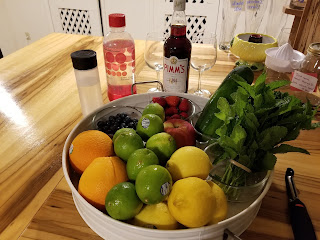
Spread for Cup preparation
McMillian's cup has a few distinctive notes that I'd like to highlight:

1) He builds his cup in a wine goblet, and throws the drink between two goblets to mix. Few cocktails are "thrown" anymore (outside of the Blue Blazer, which is a really cool way to set your bar on fire if you are not practiced), but it works for the Pimm's Cup to gently bruise the fruit and release some juice without the pulp and violence of muddling.

2) He includes a wide array of fresh fruit in the drink, but also includes a fresh mint sprig for garnish. Placing freshly smacked mint in the center of the wine goblet gives the imbiber a wonderful nose-full that compliments the cucumber and berries.

3) I'm used to seeing cucumber wheels in a Pimm's Cup, but McMillian uses a Y-peeler to slice long vertical strips of cucumber. This gives more surface area for the cucumber juices to meld with the drink, and its also really visually appealing!

I've loved this drink, and it is a wonderful summer sipper. While we're almost ready for fall, you can still find many of the seasonal berries listed below, so take advantage of a few weeks left of nice weather while you can, and sip one of these on your back porch as the sun sets!

Here is the recipe for Chris's Pimm's Cup, as found on NOLA.com with my notes added:
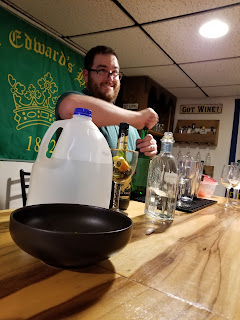
Zack mans the bar at cocktail club #1
1) Prepare your produce - Chris uses blueberries, strawberries, oranges, apples, lemon, lime, and cucumber. Blueberries need no preparation. Core and half the strawberries. Slice the orange and apples into thin wedges and remove any pith/seeds from the inside of the fruit. Do the same for the lemon and lime, taking particular care to remove the pith from the center. Finally, use a Y-peeler to slice long, vertical strips of cucumber. I like to use one strip with peel and one without.

2) Place all of your produce into a large wine goblet: 3-5 blueberries, 1-2 thin wedges of orange, apple, lemon, and lime, and 2 long strips of cucumber. Add the following liquid ingredients:

4 oz Pimm's No. 1
1 oz lemon juice
1 oz 1:1 simple syrup
0.5 oz soda water

3) Top with a small scoop of ice (5-6 cubes) and toss between two wine goblets. Garnish with a sprig of freshly smacked mint, placed in the center of the goblet, and serve.

I hope you enjoy your Pimm's Cup! I made them at my inaugural "cocktail club" last month, and they were a hit!

Saturday, July 14, 2018

June/July Drinks of the Month - Gooseberries?

Red Gooseberries
Since I've become a quasi-stay-at -home dad this summer, I've developed a greater appreciation for our local farmer's market, and the opportunities it affords for distracting young children. Our local farmers market has an awesome stand that always has weird, regional produce. Last month, Wolf Farms had all kinds of stuff you would never find in the supermarket: I bought red and white currants, and a whole pint of red gooseberries. I had no idea what to do with any of them, but they were reasonably priced, and I like to experiment. The currants are too small to juice, so I've mostly fed them to the little man (he thoroughly enjoys them). But the goosenberries are good sized, and a great mix of tart and sweet. So I set to researching applications, and found a few good ones! Gooseberries are still ripe, so if you can find them near you, here are two drinks to try. One is little more labor intensive than the other, but... you can decide!

June: Gooseberry Margarita

One application for the gooseberries is to make a steeped syrup. Gooseberries have stems and tails that need to be removed (you can just pluck them off). Remove the debris, and crush 1 1/2 cups in a mortar and pestle. Scrape the crushed berries into a saucepan with 1/4 cup of water and bring to a boil. Add 1/3 cup of sugar and stir until it dissolves completely. Remove from the heat and allow to cool before straining the mixture of solids using a cheesecloth or fine mesh strainer.

Now that you have your gooseberry syrup, you're ready for some margs! In a Boston shaker, combine the following:

1 oz gooseberry syrup
1 oz lime juice
2 oz blanco tequila
0.25 oz Grand Marnier

Shake over ice, and strain into a coupe glass (I was lazy and served mine in a cocktail glass)
. Top with a splash of soda water and serve! The gooseberry adds a nice extra hit of tart flavor, and it comes out a really pretty pale pink color (the picture won't do it justice). Enjoy your Gooseberry Marg!

July: The Goose and Berry (a Dark and Stormy riff)

The other application for gooseberries that I found was gooseberry ginger beer. I've made homemade ginger beer in these pages before, but never with gooseberries! The recipe I found came from the UK, so there is some ingredient and proportion translation needed, but here is what I came up with:

Gooseberries a-roastin' (I used way too much
sugar - it was a conversion oopsie. Dang Brits).
Stem and tail 3 cups of gooseberries. Pre-heat your over to 400 degrees, and line a roasting pan with wax paper. Place your cleaned gooseberries on the lined pan, and cover with 2 1/2 cups of granulated sugar and a teaspoon of ground ginger. Roast in the over for 25-30 minutes. The berries will burst and combine with the sugar to make a syrup. Once the berries are roasted, place them in a blender with 1/3-1/2 cup fresh diced ginger (depending on your ginger-level preferences),  Add the juice of 2 lemons and 2/3 of a cup of raisins. Blend until smooth, and then pour into a large
saucepan. Add 2 liters of cold water, and briefly bring to a boil for 2 minutes. Remove the mixture from the heat, and allow to cool to room temperature. Stir in one packet of active yeast, and place in refrigerator overnight. In the morning, transfer the ginger beer into 2 empty 2 liter bottles, leaving at least 1/4 of the bottle empty. Place the cap on loosely and allow to rest for another day in the refrigerator before serving. The yeast should jump start carbonation, which will leave the bottles feeling full-pressured (so use caution when opening).

Once your ginger beer is done, you can build your drink:

In a Collins glass, combine 1.5 oz of dark rum (we use  Plantation OFTD overproof) with 0.5 oz lime juice. Fill with ice, and top with the gooseberry ginger beer (approx 4-6 oz). Serve with a lime wheel. Enjoy the Goose and Berry!

May Drink of the Month - The "Blade"

Two preface notes before I begin: 1) It is July, not May. I've been a bad online host for all of you. I will aim to fix this over the next few months, starting with today's original concoction. 2) I'm never letting Jonathan Solie name a drink again. He is bad at this game. With those minor concerns addressed, lets move on to a cocktail...

I was purging my spice cabinet last month, when I came across a package of dried hibiscus flowers. I had purchased them over a year ago at the local Mexican grocery, hoping to do something fun with them. Instead, the wound up pushed in the back by other random spice purchases (ras el hanout anyone?), doomed to be forgotten. But by a stroke of luck, I found them recently. And happily, I found them on a day when I was excited to be creative in the kitchen, So I made myself a fresh batch of hibiscus syrup, and all was right with the world. Like most steeped syrups, this one is easy to make - steep 2/3 to 1 cup of dried hibiscus flowers in hot (not boiling) liquid for 15 minutes. Strain to remove solids, and then add an equal volume of sugar to make a 1:1 syrup. Ann recently got roped into multi-level marketing (hello Tupperware - did you know they still exist?), so I benefited with some cool squeezy-top 8 oz bottles for my syrups. They travel well and fit into a mini fridge perfectly, so if you know any tupper-ladies or tupper-fellas (I feel so stupid right now, but that is the actual terminology in their magazines), I highly recommend them.

Once I had my syrup made, I had to decide what to do with it. Hibiscus is tart like a cranberry, with some sweet notes. Add the sugar, and you get something like cranberry lemonade, but with added health bonuses (lower blood pressure! other homeopathic benefits!). I decided I would use this for a sidecar riff (have I mentioned that I love a good sidecar

?), replacing Cointreau with the hibiscus, and subbing in Singani 63* for the brandy. The result is a striking red cocktail that is equal parts tart, sweet, citrusy, and earthy. All that was left to do was name the drink.

This is where the second disclaimer above comes into play. Last weekend, I was in Minneapolis for a wedding. I stayed with my friend Solie, and I made him a variation of this drink (using pisco instead of Singani, because that is all I could find in the Wisconsin liquor mart). I asked for his advice on a name. I knew that our Hispanic friends called hibiscus tea Jamaica, so I was trying to think of something along those lines. Solie had other ideas. That evening, we were watching the classic movie "Blade" with Wesley Snipes (after watching an episode of Community that featured the movie). And Solie, Mr. Creativity, decided that my drink looked like blood, and so he dubbed it the "Blade" cocktail. And the name stuck, because I want to shame him for his lack of effort. So check out the recipe below for the "Blade":

Clearly not my bar...
In a Boston shaker, combine the following:

2 oz Singani 63
1 oz hibiscus syrup
1 oz fresh squeezed lemon juice

Shake over ice, strain, and pour into a cocktail glass. No garnish required, unless you have a fresh hibiscus flower. But who has time for that?

*Singani is a Bolivian muscat brandy. It is similar to pisco, but with a little more fruity/floral notes (almost closer to an eau de vie). Singani 63 is the brand found currently in the states, imported by director Steven Soderbergh (becasue - of course).

I hope you enjoy your "Blade"!

Wednesday, May 2, 2018

April Drink of the Month - Sweet Pea Cocktail

The other night, I was watching Iron Chef: Gauntlet (legitimately my favorite thing on TV right now). One of the chefs made a sorbet out of an ingredient called "Butterfly pea flower tea," which was an amazing, vivid blue color that you don't find most places in nature. I actually read a whole article on the stuff after watching the show (link), but what I remember most was one of the judges saying that she would not eat anything that blue on principle. I feel the same way about ingredients for cocktails - there are some that seem so outlandish that I would never consider them (sweet potatoes? peas? artichokes (ugh, get your Cynar away from me)? After spending a month enjoying the Sweet Pea Cocktail, I might be open to changing my worldview, at least where one ingredient is concerned.

The cocktail for this month came from my latest issue of Imbibe magazine, in a section highlighting fresh spring flavors. Apparently Lillet Blanc and sugar snap peas combine to provide the "essence of spring." I was incredibly skeptical... but after trying the drink, I can't say that I disagree! The drink combines a neutral spirit (vodka), with a sugar-snap pea infused simple syrup, lime juice, and Lillet Blanc. The combination is earthy and vegital, but also sweet and bright. There is a distinct snap pea flavor on the tail of each sip, but it is mild and pleasant, not bracing. If you don't mind committing to making this a few times (because making 4 ounces of syrup is not worth anyone's time), this is an excellent drink to start out your spring (now that it is actually here, and not faking it, like last month).

In a cocktail shaker, combine the following:

1.5 oz vodka
1 oz sweet pea syrup 1-1*
0.5 oz lime juice
0.25 oz Lillet Blanc

Shake over ice, strain into a coupe. Garnish with a pea pod wrapped in a lime wheel.

*Sweet Pea Syrup: Wash and roughly chop 1/2 cup of sugar snap peas (about 12-15 pea pods). Place in a pot with 1 cup of water. Bring water to a boil and slowly mix in 1 cup sugar, until combined. Reduce heat to simmer for 10 minutes, allow mixture to cool/steep for 20 minutes before straining out peas and bottling. Will keep for 2 weeks if refrigerated.

We hope you enjoy your Sweet Pea Cocktail!

Thursday, April 12, 2018

March Drink of the Month - Harvey's Firecracker

Sometimes, the best riffs are the simplest ones. Take something that is already good on its own and add one ingredient to pump up the flavor. That is what we did down in the bar laboratory last month, seeking to improve on a classic: The Harvey Wallbanger. A simple combination of vodka, orange juice, and Galliano (an anise-flavored liqueur with strong vanilla notes, making it much sweeter than its cousins Pernod and Sambuca). Frequent collaborator and friend of the bar Zack and I took that simple mix and played around for a bit, resulting in our cocktail for the month.

Before we dive in to the drink, who is Harvey Wallbanger you may ask? Well, according to historian David Wonderich, he was probably just made up to help sell Galliano. The many stories around the drink's inception were revealed to be fictional, the work of advertising executives who wanted to tap into the "California cool" vibes of the 60s in order to sell more bottles of the key ingredient. Those executives took the classic Screwdriver (vodka and OJ) and added in their new product. The resulting concoction adds some sweetness and some bitter, making the drink a little more complex.

The Harvey Wallbanger was one of the first drinks I learned how to make when I took an online bartending class. The class was a joke, and the key learning for the series seemed to be teaching prospective mixologists how to build complicated drinks with naughty names. A Screwdriver in a highball glass becomes as "long screw." Add some sloe gin, and it is a "sloe, long screw." Add some Galliano (making it a Harvey Wallbanger with a sloe gin float) and you have a "sloe, long screw up against a wall." Southern Comfort makes it a comfortable screw, and so on. Apparently this bartending class has a dirty mind, but this was the language for call drinks before the cocktail revolution.

I suppose if you were to categorize the drink Zack and I came up with, you could call it a "fiery screw up against the wall." We added one of citrus' best friends, jalapeno. The spice of the jalapeno mixes well with the orange juice, and adds another note to the anise/vanilla. Adding jalapeno gives you citrus/spice and sweet/spice combos, which are both delicious. We simply subbed 0.25 oz of vodka for the jalapeno spirit (a little goes a long way), and went to town. When it came time to name the drink, I asked Zack to use Google translate to convert "Wallbanger" into Spanish. He put "wall" and "banger" in separately and came up with "pared petardo." Which is funny. But I was curious what "petardo" really meant - surely there is not a Spanish word that just means "banger." It turns out "petardo" is firecracker, which rolls of the tongue nicely. So we settled on Harvey's Firecracker, the recipe for which you can find below:

In a mixing tin, combine the following:

1.25 oz vodka
3 oz fresh orange juice
0.5 oz Galliano
0.25 oz Jalapeno liquor*

Shake over ice, strain into a cocktail glass, with an orange peel garnish.

*We used Journeyman Humdinger Jalapeno, but any spicy spirit will work

I hope you enjoy your Harvey's Firecracker! Up Against a Wall or otherwise!