Sunday, November 9, 2014

November Drink of the Month - Dark and Stormy (and Homemade Ginger Beer)

The first drink I ever made for Ann Mason was a Dark and Stormy. It was our fourth date, and we had just come into my house after being nearly swept away in a mid-summer South Bend monsoon. Their was a hockey play-off game on TV and my crazy roommates were still out on the porch, air-drying after frolicking around in the rain like pagans. Good times. I'd love to say that I chose to make the Dark and Stormy the drink of the month in honor of just passing the one year mark until our wedding, but that would be untrue (although it does make way better copy than what is to follow). Instead, Zack and I had both come across recipes for Ginger Beer - and what better way to taste test homemade Ginger Beer than in a Dark and Stormy? Below are the two recipes we tried out and then the recipe for the Dark and Stormy. The process is simple and only takes a day or two to ferment, so I hope you make your own Ginger Beer!

The first recipe we tried came from Imbibe magazine. They've been on a bit of a ginger kick lately. Two of their last four DIY recipes have been ginger themed (this month they have a recipe for homemade Ginger Liqueur, which I will clearly try out soon), so it was only a matter of time before I tried the recipe. Here is their step-by-step process:

1) Peel and coarsely chop 4 ounces of fresh ginger.
2) Place ginger in blender with 4 cups of filtered water and pulse until roughly puréed.
3) Pour mixture into a saucepan over medium-high heat. Add 1 cup turbinado/demerara sugar and 1 tbsp molasses. Stir until sugar is completely dissolved. Then remove from heat and allow to cool to just above room temperature.
4) Pour mixture into a 2-liter bottle, straining out and particulates through a double layer of cheesecloth. Make sure to squeeze the cheesecloth to extract as much liquid as possible.
5) Add 3/4 cup of fresh squeezed lime juice (fine strained to remove any particulates) and top off the 2-liter bottle with up to 4 more cups of filtered water until liquid is about 3 inches from top of the bottle.
6) Add 1/4 teaspoon of champagne yeast to the top of the mixture. Squeeze the bottle until the liquid comes up the neck (so that there is room for the bottle to expand as the mixture ferments). Screw the cap on tightly and let the bottle sit at room temperature for 12 hours, or until it is firm.
7) Move the bottle to the refrigerator, keep for up to one week.

This recipe produces a very dark ginger beer and the molasses flavor stands out nicely. The drink looks like root beer and has a nice spice aftertaste. It fermented very quickly - make sure to use care when opening the bottle for the first time so you don't get covered in carbonated fizz! This recipe was my favorite of the two we made. We also added a little clove to the mixture in the sauce pot, but the flavor was not terribly noticeable.
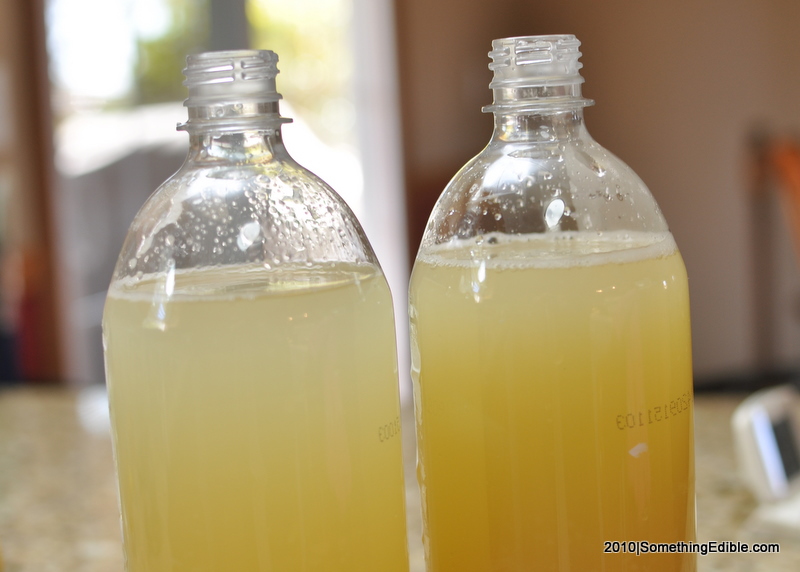

The other recipe we tried came from the Bar Book (which I mentioned in September). We adjusted their recipe in order to take advantage of the same empty 2-liter bottle method employed in the Imbibe recipe. The Bar Book recipe makes a gallon and then batches it out into 16 oz bottles. We modified it to make a single 2-liter bottle's worth. Below is the step-by-step process: 

1) Make 5 ounces of ginger juice by pulsing 3/4 cup of peeled, coarsely chopped ginger in a blender with enough water to create a thick liquid. The consistency should be much closer to smoothie than stew, but be careful not to add too much water. Strain the mixture through a double layer of cheesecloth, making sure to squeeze the cheesecloth to extract as much liquid as possible.
2) In a large container, combine the 5 ounces of ginger juice with 4 1/2 cups of warm, filtered water, 8 ounces of freshly squeezed, finely strained lemon juice, and 14 ounces of 1:1 simple syrup. Stir the mixture for 2-3 minutes to ensure that all the ingredients are well mixed.
3) Pour mixture into an empty 2-liter bottle (up to 3 inches from top of the neck) and then add 1/4 teaspoon of champagne yeast. Squeeze the bottle until the liquid comes up to the neck, then close the cap tightly.
4) Shake the mixture well and then store in a warm dry place for up to 48 hours, until the bottle has expanded.
5) Move the bottle to the refrigerator, keep for up to one week.

This recipe was slightly more involved - it required pre-making simple syrup and the ginger juice making process was a bit messier than the ginger-water process for the Imbibe recipe. However, Zack liked this recipe better. The result looks very different - this ginger beer looks like cloudy lemonade and has a much sweeter taste (but still has the nice, spicy ginger finish).

One quick note: where do I find ginger? Might I suggest your local Hispanic grocery store? We found fresh ginger for less than $1.50 a pound, whereas it retailed for over $4.50 a pound at our usual supermarket. Champagne yeast can be found at any local home brew store - we used Montrachet yeast at the suggestion of our local guys.

You can use either of these ginger beers to make a Dark and Stormy. Technically a Dark and Stormy should be made with Gosling Ginger Beer and Gosling's Black Rum (they own the trademark for the name), but any dark rum works. However, do not use dark spiced rum, such as Kraken, as the combination of spiced ginger beer and spiced rum can be off-putting. The (extremely simple) recipe is below:

1) Fill a Collins glass with ice.
2) Add 2 ounces dark rum (I use Myers Dark) and 4 ounces ginger beer.
3) Squeeze in the juice of 1/4 lime and drop in as garnish.
4) Serve with a straw for stirring the drink.

 Enjoy your Dark and Stormy!

Monday, October 6, 2014

October Drink of the Month - The BB Gun (and Fun with Shrubs!)

The most recent issue of Imbibe magazine decided to run a feature this month on shrubs. Sometimes called "drinking vinegar," a shrub is a combination of fruit (and sometimes herbs), sugar and vinegar. Shrubs first popped up in North America in colonial times and gained popularity during the temperance movement as a alternative to spirits. Recently, shrubs have gained popularity as a replacement for bitters, especially in rum and brandy cocktails. They have a really unique sweet and sour flavor and are pretty easy to make at home.

There are multiple ways to make shrubs, but one of the easiest is the cold-process, a means of preparation that takes a little time, but yields a beautiful product. Using a process called maceration (letting the fruit soften in juices in order to extract the flavor) we slowly release the flavor of the fruit and combine it with the acidic vinegar to produce our shrub. For today, we'll detail the process of making a blackberry shrub, and then offer two preparations - as a soda or as a the BB Gun Cocktail (from Jessica Braasch via Imbibe).

To make the blackberry shrub, wash and place two cups of blackberries in a mason jar. Sprinkle 1/2 cup of sugar over the blackberries (I used turbinado sugar since we will be pairing this shrub with aged rum in the cocktail). Allow the berries and sugar to sit for 12-24 hours. Similar to the preparation for strawberry shortcake, the sugar will slowly draw out the juice from the berries, resulting in a sweet, dark syrup. Gently shake the jar and/or crush the berries from time to time to make sure as much berry surface area comes into contact with the sugar as possible. After the allotted time, add 1 cup of apple cider vinegar to the jar. Stir occasionally to make sure all the sugar is dissolved. Allow the mixture to sit, covered, for another 24 hours. Finally, strain the mixture using a fine mesh strainer into a clean jar. Press on the berries in the strainer with a wooden spoon to extract all of the good juice out of the berries before discarding. You should be left with a beautiful, clear dark purple liquid (that will stain your counter top like the dickens, so be aware).

The shrub can be used on its own to make a soda by combining it with seltzer water. Simply add the desired amount of shrub to a glass and top with soda water. I used 2 oz of shrub and 8 oz of soda for a refreshing, sweet and sour concoction. If your tastes run sweeter, you can also add a splash of simple syrup to the mix.

However, our reason for making the shrub was to try out a new drink featuring aged rum. Below is the recipe for the "BB Gun" recipe from Kask in Portland:

In a cocktail shaker, combine the following ingredients:
1.5 oz aged rum (I used Bacardi 8 Anos - this is the most readily available)
1 oz blackberry shrub
3/4 oz fresh lime juice
1/4 oz 1:1 simple syrup (I ended up using closer to 1/2 oz, but I'm an unrepentant "sweet" drink guy)

Shake over ice and strain into a Collins glass filled with ice. Top with soda. The recipe calls for a garnish of mint leaves and a lime wheel.

The drink has an incredibly different taste from most cocktails. The lime helps bring out the tartness of the vinegar even more than when the shrub is alone with soda water. The blackberry adds nice sweetness and the rum is a great base for the drink, adding just a hint of smokiness. This would make a great porch sipper for the end of summer or perhaps for when you are cooped up in your kitchen on a cold October day, trying to remember that summer will one day return.

Enjoy your BB Gun! 

Monday, September 1, 2014

September Drink of the Month - the Caipirinha

Happy September friends! I'm so sorry I was unable to post a drink of the month for August, but it's been a busy month for me. I started the month moving across campus from Zahm House to Duncan Hall, where I will be an Assistant Rector (hall director) for the 2014-2015 school year. As soon as I moved my last box, Ann and I departed South Bend for a week of vacation with my family in Virginia. We got back just in time to attend a wedding and then I began a week of training for my new job. During that time period, I also interviewed for and was offered a job for next year as the Director of Religious Education at parish here in South Bend (which I accepted - I'll be beginning part time in January and then I'll start full time in July). Life goes on, as the next week we had a retreat for our MDiv program and the first week of classes. Finally, I closed out the month by proposing to my (then) girlfriend Ann Mason (because now she's my fiancee!) - and she said yes! So you'll forgive me my (three) loyal readers if I'm a bit behind - over the course of August I moved, went on vacation, started a new job and interviewed and was hired for another one, started my last year of grad school and got engaged. What an exciting month!

In honor of Miss Ann Mason, who won me over with the promise of a friendly bartender serving "bigger than normal" rum and cokes when we first met, this month's drink features Cachaça, the Brazilian evil twin to Caribbean rum (Ann, we'll do something Christmas-y next month, I promise). Like rum, Cachaça is made from sugarcane. However, unlike rum, which is usually made from molasses (processed sugarcane), Cachaça is made from fresh sugarcane juice which is then fermented and distilled. The liquor has many colorful nicknames in Brazil, including "heart-opener" and "tiger breath" (as well as "eye wash," which is less flattering).

The Caipirinha is the most ubiquitous Cachaça beverage. Its name roughly translates as "little hillbilly," but the term is somewhat archaic - the term is much more commonly associated with the drink than any social classes. It is an extremely simple drink to make, featuring only four ingredients - ice, lime, sugar and Cachaça. The artistry in this drink comes in finding the correct proportions and in the technique used to prepare and muddle the lime, and finding the correct (fresh) ingredients. The classic IBA recipe calls for brown sugar , but most bartenders use white superfine sugar.

Here is the recipe for the Caipirinha:

Begin with 1/2 of a lime cut into four quarters (lengthwise) in an Old Fashioned glass. Top with 2 heaping
teaspoons of superfine sugar (or try out brown sugar if you wish). Muddle the lime and sugar together.* Top with 2 ounces of Cachaça, and then add crushed ice to fill the glass. No garnish is needed.

*I'm currently reading through bartender Jeffrey Morgenthaler's "The Bar Book" which places a premium on technique, so I will follow his admonition about muddling:
Cut your [limes] into quarters... put the citrus in your glass, preferably peel side up, and then add the sugar. Work the cirtus by pressing and twisting it with the muddler, grinding the sugar into the peel. The sugar acts as an abrasive and helps liberate the citrus oils and juice. As the juice is released, it will form a syrup with the sugar. Press and twist until you see a nice syrup forming and you smell the fragrance of citrus zest. A good bartender uses every sense, and your sense of smell is one of the most critical tools (p. 235).
Morgenthaler's book is really great. He claims this is one of the first books that focuses not on recipes or ingredients, but on bar technique, and he goes into extreme detail - his whole first chapter is on how to select and prepare citrus (for instance, limes should always be cut across the "equator" - in between the stem and the nubbin. He also tells us that there is absolutely no difference in juice production between room temperature and refrigerated limes. Who knew?). I highly recommend the book, and I hope to have another post up this month after digging deeper into his work - he is also featured in my July issue of Imbibe magazine, so I'm excited to keep reading!


I hope you enjoy your Caipirinha (with your properly muddled limes of course)!

Saturday, July 5, 2014

July Drink of the Month - Dragonberry Lemonade

As much as I wanted to make a red, white, and blue shooter for the Fourth of July, most of these drinks are gross. If you want to poison your insides with blue curacao, peach schnapps and grenadine (top to bottom order), then please be my guest. But as much as I love sugary drinks, that above combination is a little bit too much for me. Even I have my limits when it comes to sugar.


Instead, I've decided that - in honor of America - we're going to make a twist on a classic American drink: lemonade. The drink of the month, Dragonberry Lemonade, was something I tried last week at Wally's in Sagatuck, MI. While the bartender was not on hand to give me his recipe, I came home and I believe I've been able to recreate the drink fairly faithfully. The drink is named for the main ingredient, Bacardi Dragonberry flavored rum, which is rum infused with strawberry and dragon fruit. It also features one of my favorite ingredients, St. Germain elderflower liqueur, as well as ginger beer for a little extra spice and muddled fruit for texture and little bursts of sweetness in the midst of the tart lemon flavor. I hope you enjoy the heck out of it!

Dragonberry Lemonade

In a cocktail shaker, combine the following ingredients:
2 oz Bacardi Dragonberry rum
1 oz St Germain
1 oz simple syrup (1:1 water/sugar)
1 oz fresh lemon juice

Shake over ice, strain and pour into a highball glass. Muddle in 4-6 strawberries or raspberries. Add ice and top with ginger beer (approximately 4 ounces). Stir and serve!

Enjoy your Dragonberry Lemonade!

Saturday, May 31, 2014

June Drink of the Month - The Slivopolitan

Last month, I bought a bottle of Eastern European plum brandy (called Slivovitz here in the US). It belongs to a family of fruit brandies that my Hungarian relatives would call Palinka, but its also called Rakia in the Czech Republic and elsewhere. My mom did some digging into our family tree, and she is pretty convinced that some of her relatives bootlegged this stuff during Prohibition. I can confirm that it is still a staple of the Hungarian Cultural Club in Cleveland, OH - my mom went up for a dinner a few months ago, and they had an ice sculpture that dispensed frosty Palinka for their guests.

I was first introduced to Slivovitz by my great uncle Jim, who always had a bottle or two in his freezer, as any good Hungarian should. After buying my very own bottle, I sent my mom a picture, thinking she would appreciate my attempts to appropriate my ethnic heritage. Below is the transcript of our conversation:

Me: [Picture of bottle of Slivovitz] Uncle Jim would be proud!
Mom: Where is this and are they passing it through an ice sculpture to chill?
Me: In my fridge, getting icy.
Mom: So you willingly bought that paint thinner to consume on purpose?
Me: Its your fault that I'm half Hungarian. I blame genetics.
Mom: In the morning, you'll be blaming that rot-gut.

As you may be able to decipher from the conversation above, the problem with Palinka is that it is just  *tad* bit on the harsh side. It has a strong bite that is evident when you first taste the clear liquor and gets stronger as it works its way down your throat. I'm doing a great job selling this so far, right? But here's the thing - if you can get past the sharpness (or if you're numb to it after years of liver abuse, as must be true of all Eastern Europeans), it has a really unique, nice taste! I really don't mind Slivovitz by itself, but apparently its not for everyone (Ann gave me a really dirty look after I made her try it - did I mention Palinka has a strong bite?).

My mission this month was to find a way to make Slivovitz palatable for friends and family, and so I scoured the internets hoping to find someone brighter than me who had discovered a way to prepare a drinkable Slivovitz cocktail. The fine folks at Liquor.com came through in spades with their suggestion of making a modified Cosmopolitan (named after the magazine by bartender/creator Cheryl Cook) with plum puree in place of cranberry juice and Slivovitz in place of vodka. Below you will find the recipe with a few slight modifications and suggestions. Try it without fear! The drink it produces is sweet and fruity with some nice complex notes underneath the sweetness to keep it interesting. You can taste the brandy, but without the bite, and the fruit puree adds a nice color and texture to the drink! You can also make this as a frozen drink, which I actually prefer. You'll find that modified recipe below as well. And I'm happy to report that Ann even likes this one - she even asked me to make it for her a second time. Success!

The Slivopolitan

In a cocktail shaker, combine the following:

1.5 oz Slivovitz plum brandy
1 oz Cointreau
0.75 oz plum puree*
0.5 oz lime juice

Shake over ice for ten seconds and strain into a martini glass. Garnish with a slice of plum.

*To make the plum puree, wash and PEEL four small plums. While the plum peel add nice flecks of color to the drink initially, the peels tend to congregate on the bottom of the glass and make the lat few sips much less appetizing. Peel your plums! Dice the peeled plums and place them in a blender. Add 3-4 drops of vanilla extract and add 1-1 simple syrup as needed to allow the mixture to blend well (maybe a little less than 1/4 cup). Blend until smooth and store in a airtight container. The mixture will initially be pure white, but will turn orange-purplish after a day or two. Don't worry, the puree is still good even after the color change!

To make the frozen Slivopolitan, follow the modified recipe below (makes 4)

In a blender, combine the following:
1 1/2 cups Slivovitz plum brandy
1 cup Triple Sec (no sense wasting the good stuff on a blended drink!)
3/4 cup plum puree
1/2 cup lime juice

Fill blender with ice and blend until well crushed. Serve in a lowball glass without garnish.

Enjoy your Slivopolitans!

Tuesday, April 29, 2014

Cocktail Night Menu - Bar Kiley 4/26/14

Occasionally, over the course of the year, Bar Kiley goes on the road and I bartend cocktail nights for my friends. Usually these evenings feature a limited menu - this keeps my costs down and helps keep people who are used to beer/wine from getting overwhelmed by too many options. My classmates asked me to post my limited menus, and so below I offer you the cocktail night menu I constructed for my little sister's college graduation party this weekend.

Katie asked that I feature rum and gin in her menu, as these are her favorite. In addition to these two ingredients, I would also always recommend including a sparking beverage of some sort - this is a must for non-cocktail drinkers, and these beverages have a much lower alcohol content, so those with lower tolerances can still enjoy a drink during the party. I decided to feature dark rum and heavy fruit content for Katie's rum drinks and offer lighter beverages featuring gin. Originally, I was going to offer an Aviation as one of our gin drinks, but Katie nixed this - she was not a big Maraschino fan. With those quick notes in play, here is the cocktail menu from Bar Kiley on Saturday, April 26th:

RUM 
Planter’s Punch * Meyers Dark Rum * Pineapple Juice * Orange Juice * Lime Juice * Grenadine * Angostura Bitters * Splash of Club Soda * served on the rocks 
New Orleans Style Hurricane * Meyers Dark Rum * Bacardi Silver Rum * Passion Fruit Juice * Orange Juice * Lime Juice * Simple Syrup * Grenadine * served on the rocks 
GIN 
Bog Punch * New Amsterdam Gin * Cranberry Juice * Ginger Ale * served on the rocks 
Aruba * New Amsterdam Gin * Curacao * Fresh Squeezed Lemon Juice * Orgeat Syrup * Egg White * served shaken and chilled 
SPARKLING 
Saint Germain Cocktail * Saint Germain Elderflower Liqueur * Club Soda * Champagne * served chilled

Recipes for the Aruba and the Hurricane are available on the blog. Below are the recipes for the other three beverages:

Planter's Punch: In a cocktail shaker, combine 2 oz dark rum, 1 oz orange juice, 1 oz lime juice, 1/2 oz pineapple juice, 1/2 oz grenadine, 2 dashes bitters. Shake over ice, strain into a highball glass with ice, top with 1-2 oz club soda. Garnish with a pineapple wedge.

Bog Punch: Build the following ingredients in a highball glass over ice and stir before serving: 2 oz gin, 3 oz cranberry juice, 3 oz ginger ale. Garnish with a skewered cranberry.

Saint Germain Cocktail: This drink is best made by the pitcher, but for a single drink, combine 1.5 oz Saint Germain, 2 oz champagne, and 2 oz club soda (in that order). Serve in a highball glass over ice.

I'll try to post other menus as I bartend, but I hope you enjoy these drinks!

Monday, April 28, 2014

May Drink of the Month - Sir Robert the Savage

South Bend has a new whiskey bar, and I couldn't be more excited. The Exchange opened up in the Citizens Bank and Trust building in the heart of downtown a few months ago, and their selection and staff is excellent. Their specialty is whiskey, served neat or on the rocks (and never with cola, as the menu explicitly points out), but they also have a great short list of mixed drinks that feature a few of their whiskeys. One of the ones I enjoyed trying last week was "Sir Robert the Savage." As far as I can tell, this cocktail is unique to The Exchange - I couldn't find it or anything similar online (which is awesome).

Eventually, I will need to visit The Exchange again and get their recipe for this drink. The menu gives us the four main ingredients (Bushmills Irish whiskey, Creme de Cassis, Orgeat syrup, and lemon juice), but it is up to us to discover the exact proportion of each ingredient. We've encountered most of these ingredients before (need an Orgeat primer? Click here), but Creme de Cassis is a new one for us. Originating in France, Creme de Cassis is made from crushed blackcurrant berries soaked in ethanol. It is a dark red (almost purple) digestif that is the favorite drink of Agatha Christie's famous French detective Hercule Poirot. It is most commonly used with white wine to make the cocktail Kir, but also has many other uses.

I spent a few hours on Saturday experimenting with different ingredient combinations, trying to recreate the purple cocktail I tried at The Exchange last Wednesday night. Below, you will  find a recipe that features my best guess for the cocktail. If the folks at The Exchange are nice enough to give me the recipe for their drink, I will update the blog later with their recipe as well. But whatever the result, an afternoon spent experimenting with cocktail construction is never an afternoon wasted (even if some of the combinations I tried were quite undrinkable - 2 oz of Dewar's scotch combined with a 1/2 oz of lemon juice, 1/2 oz of creme de cassis, and 1/4 oz of orgeat syrup is a recipe I will never plague the world with again).

Sir Robert the Savage - My Best Guess
In a cocktail shaker, combine:
2 oz Bushmills Irish Whiskey
3/4 oz Orgeat Syrup
1/2 oz lemon juice
1/2 oz Creme de Cassis

Shake over ice and strain into a rocks glass filled with ice.

I hope you enjoy this combination! Its a little on the sweet side - if that bothers you, you can reduce the amount of orgeat syrup, but don't go below 1/2 oz. If you do decrease your orgeat content, you may consider adding more Creme de Casis.

Enjoy your Sir Robert the Savage!


*Edit* I finally got back to The Exchange last night and my server was kind enough to share the recipe with me. I was pretty stinking close! Here are their mix proportions: 2 oz Bushmills, 3/4 oz Orgeat, 3/4 oz lemon juice, 1/2 oz Creme de Cassis.