I'm going to start off this post with a crazy, bar-related news story, and then skillfully segue way into our drink of the month. Or at least I'll make a tangential connection - but this story is too crazy to not talk about. Okay, on to the news! There is a bar in Dawson City, Yukon (Canada) that serves a drink called the "Sour Toe." Ordering the drink gets you a certificate and your name on the wall, but there is a catch - you must drink a cocktail with an actual severed, preserved human toe in it, and the toe must touch your lips! Gross. The bar has several toes, including a prized "second toe" (the one after the big toe) which is grossly bent and distorted (the previous owner of the toe had it amputated because of hammer toe and donated it to the bar - see some great/grisly pictures HERE). I should say that the bar had several toes, because one tricky customer made off with the bar's favorite hammer toe the other day, in a brazen act of robbery. If you happen to know anything of the whereabouts of the the toe, contact the bar's "Toe Captain" (yes, a real job) - there is bound to be a reward. For more juicy story details, be sure to read THIS article.
Okay, here's where I do some gymnastics in order to make a connection to my drink for this month. The Sour Toe is a drink that "benefits" from steeping a human toe in liquor. Such steeping changes the flavor of the drink the longer the additive is placed in the beverage. The Fish House Punch is another drink that has a flavor that changes over time because of an added ingredient (connection!). However, the key in the Fish House Punch is much more pedestrian than the Silver Toe - a large block of ice! The drink is designed to be kept in a refrigerator, allowing the ice to melt slowly over the course of the day, which subtly changes the flavor.
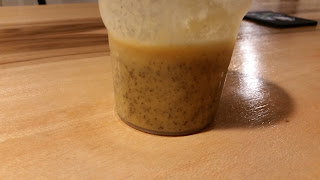
Fish House Punch is a great party drink, and its fun to make and note the shifting flavors over time. But the recipe we found calls for 32 limes and 12 lemons, and serves 15-20. What if you desire the tart pleasure of a Fish House Punch, but you don't have a citrus grove in the back yard? My bartending companion Zack and I came up with a modified recipe that makes punch for one. It can also be scaled up easily to make a small pitcher, as we did for a reception at my parents' house to welcome Charlie to the neighborhood. The punch is a delightful combination of light and dark rum, brown sugar, brandy, and citrus. Below is the recipe for the punch for one:
In a Boston shaker, combine the following:
2 oz lime juice (fresh squeezed of course)
1 oz lemon juice (ditto)
1 oz 1:1 dark brown sugar syrup*
1 oz light rum
0.5 oz dark rum
0.5 oz brandy
Shake over ice, and pour into a Collins glass filled with cracked ice. Garnish with lime and lemon wheels and/or twists!
*The original recipe calls for one cup of brown sugar to be added to the giant mix. You could add dry sugar to the citrus and stir to combine (that's what we did the first time), but making the one to one syrup (1/2 cup brown sugar and 1/2 cup water) also adds a little water, which simulates the effect of melting ice in the large-scale punch.
I hope you enjoy your Fish House Punch for One (and maybe stay away from the Sour Toe).
Thursday, June 22, 2017
Tuesday, May 16, 2017
May Drink of the Month - Garden Party Punch
On the occasion of Charlie's baptism (last Saturday, 5/13), it seemed right and proper to make a punch for our guests. We held an open house on Mother's Day, and the weather could not have been more perfect for an outdoor celebration. While my back yard is still in the process of transformation ("collection of green-ish weeds" suits it better than "garden"), a party on the lawn seemed like a fitting time to try "Garden Party Punch" from the great little book Punch Bowl by Dan Searing (link).
The key ingredient for this lovely burgundy-hued punch is Sauterne, a sweet white wine. Our favorite local winery, Lemon Creek, (which makes a to-die-for peach spumante), makes a great "Silver Beach Sauterne," which celebrates the old boardwalk amusement park in Saint Joseph, Michigan. This is tempered with Bordeaux, brandy, demerara sugar, a touch of green chartreuse, and lemon and orange juice. It tastes somewhere between cold mulled wine and sangria - really refreshing for a sunny spring day!
The recipe can be found below. Next month, I am going to offer another punch from Searing's book, the Fish House Punch. In the bar laboratory with Zack (who helped me select this month's drink), we came up with a scaled down recipe of the Fish House Punch that we really liked. However, with the recipe for the Garden Party Punch calling for whole 750 ml bottles of wine, I won't attempt any scaling here. Make the whole batch and serve it at your next spring or summer gathering! It was a hit for us!
Below you will find the recipe. Any good punch also needs an ice ring to help cool the punch and provide visual flair. I forgot to borrow my mother-in-law's bundt cake pan, so I made my ice ring using orange segments in a cylindrical cake pan. That works in a pinch, but using greased saran-wrap in a bundt mold is preferable, for the eye-pleasing ring shape it produces (and higher surface area it affords for cooling). Form your ice ring the night before (make sure to add water after you place the mold in the freezer - I had my oranges all artistically arranged, and had to re-do the whole thing when everything shifted on my way to the ice chest), and prepare the punch below about 30 minutes before serving to allow everything to marry well.
In a glass measuring bowl, combine 2 cups brandy with 1 2/3 cups demerara sugar. Stir until sugar is dissolved. Add juice of one orange (~6 tbsp), two lemons (also ~6 tbsp), and 3 tbsp green chartreuse. Stir to combine, and pour into large punch bowl. Top with 3 750 ml bottles of Sauterne (Tokaji or other white dessert wines will also work) and one 750 ml bottle of Bordeaux (or another full-bodied red). Stir and let sit for 10 minutes. Add ice mold, garnish with additional lemon or orange slices if desired.
We hope you enjoy your Garden Party Punch!
![]() |
| Finished product, ready to serve! |
The recipe can be found below. Next month, I am going to offer another punch from Searing's book, the Fish House Punch. In the bar laboratory with Zack (who helped me select this month's drink), we came up with a scaled down recipe of the Fish House Punch that we really liked. However, with the recipe for the Garden Party Punch calling for whole 750 ml bottles of wine, I won't attempt any scaling here. Make the whole batch and serve it at your next spring or summer gathering! It was a hit for us!
![]() |
| Prepping the ice molds next to Uncle David's turkeys. |
In a glass measuring bowl, combine 2 cups brandy with 1 2/3 cups demerara sugar. Stir until sugar is dissolved. Add juice of one orange (~6 tbsp), two lemons (also ~6 tbsp), and 3 tbsp green chartreuse. Stir to combine, and pour into large punch bowl. Top with 3 750 ml bottles of Sauterne (Tokaji or other white dessert wines will also work) and one 750 ml bottle of Bordeaux (or another full-bodied red). Stir and let sit for 10 minutes. Add ice mold, garnish with additional lemon or orange slices if desired.
We hope you enjoy your Garden Party Punch!
Thursday, April 27, 2017
April Drink of the Month - The Apra-Daquiri
![]() |
| Meet Charlie! |
For those faithful readers who have not heard the good news yet, my wife, Ann, and I welcomed our son Charles Joseph Kiley (Charlie) into the world on March 24 at 5:49 pm. He's just passed the one month mark now, and he's gaining weight like a champ (I wish people were as excited when I gained weight... or when I pooped for that matter). There are many, many wonderful things about parenthood, but surviving the first month (and accompanying sleep deprivation) did take a toll on my mixology time. Luckily, as noted above, this month's drink is pretty simple.
One of the benefits of living in your wife's home town is that you have easy access to eager babysitters. Ann's parents were nice enough to take Charlie for a few hours during week number two, so that we could run out and grab dinner together (just the two of us) and debrief/decompress from the first two weeks of parenting. We went to the LaSalle Kitchen, which has a great little bar program. My wife, being a big fan of anything with rum, ordered a drink called the Apra-Daquiri. This was her first cocktail post-baby, so I thought it would be appropriate to memorialize it here on the blog. The folks at LaSalle Kitchen were nice enough to pass along the recipe (yay!), which I have included in picture form. Below, you will find my slightly modified recipe. I use apricot liqueur instead of apricot nectar, and cut down on the simple syrup to help adjust the sweetness level. Here is my adjusted Apra-Daquiri recipe:

In a cocktail shaker, combine:
1.75 ounce silver rum (I used Journeyman Road's End)
0.75 oz lime juice
0.75 oz Rothman and Winter Orchard Apricot*
0.5 oz orgeat
0.25 oz simple syrup
Shake over ice, strain into a highball glass. Garnish with a dried apricot or lime wheel.
*Rothman and Winter is found in most good liquor stores. They also make an excellent Creme de Violet, which I use for my Aviation cocktails.
I hope you enjoy your Apra-Daquiri!
Wednesday, March 1, 2017
March Drink of the Month - The Gosia
Our drink for March is one of my own creation, inspired by a bottle of Żubrówka (Polish bison grass vodka) that I found at a Mardi Gras party. I'd never tried Żubrówka before, but I knew it was a favorite among bartenders, and that it went exceedingly well with apple juice. I did some light reading this morning, and found that most experts ascribe the following taste notes to Żubrówka: vanilla, lavender, thyme, "spring flowers," and, of course, grass. Żubrówka is made by steeping vodka in the tall grass that grows in the Białowieża Forest (which is favored by the local bison - hence the name). Żubrówka has a slight yellow-green hue, and usually is bottled with a blade of grass in the bottle.
I wasn't quite sure what to do with my bottle of Żubrówka (apple juice was nowhere to be found), but I remember reading that it also paired well with lime. Inspired, I decided to try my own riff on a Margarita, using Żubrówka and Saint Germain (a personal favorite for elevating Margaritas). The lime accents the grassy notes well, and the Saint Germain provides a little bit of sweetness (along with Cointreau), as well as some other floral notes to compliment the earthy Żubrówka. It is a slightly bracing, slightly sweet drink with a nice acidic backbone from the citrus to keep everything together. It was a hit at the party, so the only thing left to do was find a name for my creation.
![]() |
| My muse for this month |
Long time readers may remember the entomology of the name "Margarita" (need a refresher? See this post from 2013 - wow, I've been doing this for a while now!). For those readers who have not been around that long, the short story is that the Margarita was a take on the popular "Daisy" drink during Prohibition. A brandy drink with lemon and Cointreau became a tequila drink with lime when brandy was hard to come by. "Daisy" was a nickname for Margaret, hence Margarita (or "little Margaret). Since this drink uses Polish vodka, I decided I would use the Polish word for "daisy" as the name for my new drink. Unfortunately, "stokrotka" is super hard to pronounce, as I was informed by everyone at our party. The name I ultimately settled on is a better fit however - Gosia is a Polish nickname for Margaret (or Małgorzata in Polish), so it better fits the name scheme for the Daisy/Margarita. Now that you know where that odd name came from, enjoy the recipe below to make one at home:
In a Boston shaker, combine the following:
2 oz of Żubrówka*
1/2 oz Cointreau
1/2 oz Saint Germain
1/2 oz lime juice
Shake over ice for 10 seconds, and strain into a coupe glass (no margarita glasses please, we're using vodka here!)
Notes:
*Only one note this month - there are other bison grass vodkas on the market, but Żubrówka is officially licensed by the Polish government, and far outshines its imitators. Make the investment. Apparently, if you can find stuff from Poland, the flavors are a bit stronger. The US government bans the strong Polish stuff, so the bottles sold here are a little different, but still excellent.
I hope you enjoy your Gosia!
*Only one note this month - there are other bison grass vodkas on the market, but Żubrówka is officially licensed by the Polish government, and far outshines its imitators. Make the investment. Apparently, if you can find stuff from Poland, the flavors are a bit stronger. The US government bans the strong Polish stuff, so the bottles sold here are a little different, but still excellent.
I hope you enjoy your Gosia!
Sunday, February 26, 2017
February Drink of the Month - Shudders in a Whisper
![]() |
| Passion fruit syrup. A tiki drink's best friend! |
The Smuggler's Cove system helps clear this up for me. They break down the spirits first by raw components, then by distillation method, and finally by length of aging. They develop 21 categories, but they list 8 as essential categories for building your own "speed rack" of tiki rums. If you noticed sticky tabs on my Journeyman rum from last "month," that was my own attempt to follow the Smuggler's Cover method. Here are their eight essential rum categories, along with the brands I've purchased to use in my home bar. Each category lists component first, followed by distillation method, and then age (lightly aged = 1-4 yr; aged = 5-14 yr; long aged = 14+ yr):
1) Molasses/Evaporated Cane Rum - Pot Still - Lightly Aged: Journeyman Road's End Rum
2) Molasses/Evaporated Cane Rum - Blended - Lightly Aged: Appleton Estate Signature Blend
3) Molasses/Evaporated Cane Rum - Pot Still - Aged: Diplomatico Reserva
4) Molasses/Evaporated Cane Rum - Column Still - Lightly Aged: Flor de Cana 12 year
5) Molasses/Evaporated Cane Rum - Black Blended: Gosling's Black Seal
6) Molasses/Evaporated Cane Rum - Black Blended Overproof: Lemon Hart 151
7) Fresh Can Juice - Cane AOC Martinique Rhum Agricole - Unaged: Rhum J.M. White 100 proof
8) Fresh Can Juice - Cane AOC Martinique Rhum Agricole - Aged: Clement V.S.O.P 6 Years Tres Vieux
![]() |
| Our coupe glasses overfloweth - use a snifter if you have one to avoid this issue! |
3/4 oz lime juice
1/2 oz passion fruit syrup*
1/2 oz pear liqueur**
1/4 oz Drambuie
2 oz seltzer***
2 oz column still aged rum (#4 above)
2 dashes Peychaud's bitters
1 dash Angostura bitters
Shake over ice and strain into a brandy snifter (or if you're me, and your snifters don't exist, a coupe glass will do)
Notes:
*To make the Smuggler's Cove passion fruit syrup, combine equal parts passion fruit puree and 2:1 rich simple syrup. You can make the passion fruit puree using fresh fruit (its ripe now) or buy frozen
**We used pear brandy from Black Star Farms in Traverse City, MI. It is tasty stuff!
***We reduced the seltzer to 1 oz and added an additional 1/4 oz of pear liqueur - its less watery and more potent in our estimation with this change.
I hope you enjoy your Shudders in a Whisper (even if the name is a little creepy)!
Friday, February 24, 2017
January Drink of the Month - Oaxacan Daiquiri
Ann and I ended our 2016 by traveling to New York City for Christmas. Ann crossed off an item on her bucket list by seeing the Radio City Christmas Spectacular, we saw Something Rotten in its last few weeks on Broadway (hilarious!) and we were able to make it on to the Tonight Show with Jimmy Fallon with standby tickets (and we even made it on the broadcast when someone in the row ahead of us won an ugly Christmas sweater. All of these were noble pursuits, but I was perhaps most excited to explore some of the finer craft cocktail bars in NYC. Without making reservations ahead of time, we encountered disappointment at PDT (although the setup was fun to see - its hidden behind a sliding door in the back of an old phone booth in a hotdog shop) and Dead Rabbit Grog and Grocery. However, the experience we had at Death & Co. NYC more than made up for any of these disappointments - even Ann who was not drinking (because baby - coming soon to a theater near you) had a magical couple of hours talking with out excellent and skilled bartender while she sipped an over the top virgin pina colada.
A lack of yellow chartreuse (because baby - chartreuse is expensive!) keeps me from replicating my favorite drink from that night (a Yellowjacket with mezcal, yellow chartreuse, and jalepeno infused goodness), but I was lucky enough to find Death and Co's beautiful book in our local library, and I found plenty of wonderful recipes in there (as well as a shout out to my alma mater in the form of a profile of Holy Cross priest and drink connoisseur Fr. Bill Dailey). The end of the book featured a whole set of riffs on classic drinks, with over four pages devoted to daiquiri variations. A daiquiri is a simple combination of good rum, simple syrup, and lime juice. Some of the riffs published by Death and Co. went far afield from that simple construction, but my favorite only added one ingredient: mezcal.
![]() |
| Ingredients on display. Note the sticky on my rum, explained in the notes section below. |
Mezcal, the native spirit of Oaxaca, Mexico, is made from the pina (nut) of the agave plant (unlike Tequila, which is made in Jalisco, and made exclusively from blue agave). Many of the native Mexican spirits are regulated by region. When Ann and I went to visit my parents for Christmas, they had just returned from Jalisco, the home of tequila. But the fine people of Jalisco also make a mezcal-like spirit, which they call Raicilla. Like mezcal, it is smoky and sweeter than tequila. It packs a punch, and not everyone loved the drinks I made using my bottle of raicilla. But substituting it for mezcal in the Oaxacan Daiquiri riff from Death & Co. was a wonderful application of this fine spirit.
Scotch haters, beware. This drink is equal parts tart, sweet, and smoky. Rum provides a strong backbone for a strong smoke flavor, which is mellowed by the sweet rum and simple syrup on the finish. My parents promptly turned up their noses to this drink, but I've found myself making this drink whenever I want something simple and flavorful. It will certainly be a staple in my home bar menu, and I hope you might try it out as well! The recipe for the Oaxacan Daiquiri follows.
In a Boston shaker, combine the following ingredients:
2 oz Pot Still Lightly Aged* Rum**
3/4 oz simple syrup
3/4 oz lime juice
1/4 oz mezcal or raicilla***
Shake over ice for 10 seconds, strain and serve up. Garnish with a lime wheel if you are feeling fancy and have company over. Omit if you are drinking alone in your basement while writing blog posts.
Notes:
*Ann got me a wonderful Tiki book for my birthday: Smuggler's Cove: Exotic Cocktails, Rum, and the Cult of Tiki. They have their own helpful classification for various types rum, which I've found immensely helpful. I will try to use their system when making rum drinks on the blog in the future (and I'll feature one of their drinks next month, so get ready). If you notice the little sticky tab on my rum bottle (pictured above), this comes from their rum classification system, and it is really helpful!
**I used locally made Road's End Rum from Journeyman's Distillery. It is slightly overproof, and is excellent. It was actually recommended by the Smuggler's Cove folks in their book, so good on you Journeyman!
![]() |
| Ungarnished Oaxacan Daiquiri, because I made it alone in my basement while writing a blog post. |
***Mezcal is much more common in the US than Raicilla. But if you find yourself in Jalisco (say in Peurto Vallarta), pick yourself up a bottle. If using mezcal, make sure to avoid anything with a worm - its a cheap gimmick that is not representative of some of the fine mezcal now found stateside.
I hope you feel bold enough to enjoy your Oaxacan Daiquiri!
Wednesday, January 4, 2017
December Drink of the Month - Shirley Temple
Ann and I are not big social media people, but I think now that our Christmas card has been sent out, it is safe to announce it here that we are expecting our first child at the end of March. This is beyond exciting for us, but the one downside is that I've lost my primary taste-tester and drinking buddy. Over the holidays, I wanted to make sure that Ann had something to drink when everyone else was enjoying holiday cocktails. Taking a cue from her grandpa, I decided to create a batch of fresh grenadine for Shirley Temples. This was their treat at her grandparents' house (and I got an earful when I threw out an ancient bottle of 1970s grenadine), and I wanted to recreate it for her and her sisters.
![]() |
| Pomegranate "jewels" ready to juice |
As an added bonus, pomegranates were on sale at the beginning of December. I've covered this in the blog before, but real grenadine is not made from overly-sweet cherry juice. Instead, it is a sweetened pomegranate molasses (and "grenadine" comes from the French word for pomegranate). Home-made grenadine is much darker and richer than the pale red store-bought stuff, and it tastes a little different as well. I've made it before using store-bought pomegranate juice, but to make this extra special, I juiced my own pomegranates. I've included the instructions for making your own grenadine below with lots of pictures, but first, here is the recipe for the perfect Shirley Temple:
Fill a Collins glass 3/4 full with ice
Pour 3/4-1 oz grenadine (or to taste) in the bottom of the Collins glass.
Top with lemon-lime soda or ginger ale, leaving room in the glass to stir
![]() |
| Happy customers |
Stir well with barspoon to combine.
Top with a maraschino cherry (homemade if you please, store-bought if you're serving minors)
The Mason girls preferred Sprite Zero in their Shirley Temples, but my nephew Joey was a big fan of Vernor's Ginger Ale (as am I). My niece Molly just wanted the Sprite, no syrup or cherry. You can't please them all...
Home-Made Grenadine
Cut open pomegranate and carefully remove all the "jewels" (seeds). This is best done underwater - fill a large bowl with tap water, and cut each pomegranate in half under the water line. This reduces splatter - otherwise you wind up with a kitchen that is stained bright red from exploding jewels. Continue to work the fruit underwater to separate the seeds from the membrane. 4 pomegranates will produce approximately 2-3 cups of syrup.
![]() |
| Hazards of working with pomegranates |
Juice the pomegranate seeds using a kitchen juicer. Alternatively, you could use cheesecloth, but that is bound to be messy. Skim off any frothy residue and transfer to a medium pot.
Bring the juice to boil, and continue to heat over medium-high heat until the juice has reduced by half, approximately 15-20 minutes. Remove from stove and weigh the molasses using a kitchen scale.
Return the molasses to a medium-heat, and add an equal weigh of table sugar. Stir to combine fully, and allow to cool. Transfer to a sterilized mason jar for storage. Will keep for 2-3 weeks.
These kiddos hope you enjoy your Shirley Temples!
Subscribe to:
Posts (Atom)


